
update: Given the amount of email I've received on this post, I've updated the picture to more clearly show that the data only goes to 1990. This is why you may see news information about weapons provided by firms from other countries (e.g., Jordan, Germany, etc.) that is not captured here. The Stockholm International Peace Research Institute (SIPRI) only felt confident in their information up to 1990. After Saddam invaded Kuwait, any and all arm trades to Iraq would be a violation of the United Nation sanctions. Obviously, these sellers did everything possible to hide these sales and SIPRI certainly does not have all of this information.
In addition, SIPRI does not try to show which weapons are more effective. SIPRI calculated the dollar amount of all weapon transfers (in 1990 dollars). So in terms of dollar value, Russia was responsible for 57% of all weapon sales to Iraq between 1973 and 1990.

When I watch a television show or a movie, I like to get caught up in it. Producers want to generate that experience, so watching a well-made production should be a win-win experience. Science fiction productions are especially difficult for a producer to create, because it is harder to maintain the viewer's suspension of disbelief. Not only do producers have to semi-realistically portray fictitious events, science fiction viewers tend to catch technical errors that might slip past typical viewers (or typical editors). When errors are ridiculous, the suspension of disbelief is snapped and the producer's efforts are in vain.
For example, I remember watching Star Trek: The Next Generation when the series was fairly new and being shocked when a member of the crew scanned a planet and announced the planet's temperature was about negative 280 degrees centigrade. Absolute zero is approximately negative 273 degree centigrade. I don't remember much else about that episode, but I still remember the writers were unaware of basic high-school physics. Of course, picking on Star Trek is easy. The Federation can beam people on Borg cubes at will, but has trouble figuring out how to destroy the same cubes. Hmmm, why not beam aboard some of that anti-matter the Feds use in their engines and let physics do the rest? But picking on Star Trek is like catching fish in a barrel and I'll refrain from other examples before too many Trekkies start emailing me protests.
Friday night I was home with my wife. It had been a busy week, so we vegged out in front of the TV and watched John Doe. I've seen a few of these, and they are usually entertaining. But Friday's episode was horrible. I won't bother summarizing the plot, but Doe and his friends have four items in a briefcase. Each one of the four has an altered barcode with 14 characters instead of the normal 12. According to the show, each bar code contains a vast amount of data, but the data is only useful if the information is entered in a particular order. The characters can't try every possible combination because it would take over 40 years to do so. But Doe figures out the correct order and it takes the computer mere seconds to make sense of the data.
OK, reality check. Each altered barcode contains 14 characters. 4 x 14 = 56 characters. Using barcodes - that were read with normal scanners - to store vast amounts of information is ridiculous. This paragraph takes up more than 56 characters...
But even if we assume Doe had found four magic barcodes that could store vast amounts of information, the whole scenario still falls apart. Given four items, that all must be used, there are only 24 possible combinations (4! = 4 x 3 x 2 x 1 = 24). Even assuming it took the computer 1 minute to analyze each (and it took less than that for the proper combination), it would take less than 24 minutes to solve the problem even if the proper combination was the last one tried. So much for 40 years.
Well, now you can see why I don't watch much television. I haven't yet gone to a movie this year either, but I might go see The Core. According to National Geographic, the science isn't that bad. Even though I don't believe the loss of the Earth's magnetic field would be immediately catastrophic, the rest of the review looked promising. I might be able to suspend my disbelief long enough to enjoy the movie.
And he has posted a comprehensive article on Europe and the Post-Modern Left. Warning, it is not light reading and could serve a graduate report on the subject. It is quite interesting if you enjoy philosophy and has some interesting premises even if you do not.
I really like his main thesis - that a cold war exists between some in Europe and the States, but this war is war of philosophies. It is a very reasonable explanation for the actions of some in Europe. He also states we are losing the war because of our schools. And if we cannot get a handle on our education system, I agree we will have a problem. However, I'm not quite as concerned as the Wild Monk since I believe the children and grandchildren of the Baby Boomers are more conservative than their parents. I'm still concerned mind you, but I think there is more room for optimism.
I fully agree with the Monk's claim that Rousseau completely missed the impact of Christianity on a society. I'm not sure if it was reasonable or not for Rousseau to make this mistake, it was probably his biggest blunder. I wonder what would have happened if Max Weber had been a contemporary of Rousseau and had first written about the Protestant work ethic?
I also agree with him about the position of France and why they are anti-American. (Of course there is also the European view of things too. "It is not enough to succeed, a friend must fail." - there is a German word for this concept that currently escapes me, but many folks in Europe hold this view. I don't know when it originated, but it goes back to at least the 15th Century (Francois, duc de La Rochefoucauld. (1613-1680), maxim 34).
However, I disagree with lumping Germany and France together. While the French have clustered behind Chirac, Schroeder's popularity has crashed to record lows. I have great hope that German-American relations may improve after Schroeder leaves office in 2006. I don't have much hope for Franco-American relations to improve.
There are many perceptive points in the essay. My favorite part was the point that America should not defeat itself - if it doesn't the Left is left to shout at the wind. And his take on Chomsky comments made me laugh - very true and observant. Again, if you are interested in the impact of philosophy on current events, go read it yourself.
Per NASA's request, US military resources will monitor future shuttle flights and make these space photographs available to NASA. This request stems from the loss of the Columbia. Until a replacement for America's aging space fleet is built, this seems like a reasonable precaution so long as is it is not the only precaution to be implemented by NASA.
Impressed with how effective the US military was in the first hours in the campaign to liberate Iraq, many journalists have started second-guessing the military now that the war is into its second week. Its second week! And the coalition already has established air superiority, taken control of all Iraqi ports, and controls the majority of the country. In addition, the coalition has managed to protect most of the country's resources for its people, including dams, bridges, and oil fields. The coalition has managed to do this while (to date) suffering a remarkably low number of casualties. In addition, the coalition has done all of this while taking extreme care to minimize the number of civilian casualties and offering Iraqi soldiers many, many opportunities to surrender.
Instead of downbeat reports about 'unexpected' resistance, the media should be discussing the amazing military prowess of the coalition. The only thing unexpected about the war so far has been its rapid progress. Every casualty is regrettable, but only a fool would expect a war with no casualties. More people died from lightening strikes in the US last year than have been killed fighting Saddam's troops. I predict far more people will die from fatal car accidents in Los Angeles County alone in 2003 than all coalitions losses from the entire war.
Let's also look at a reasonable timeframe. The Taliban, a government with only a small fraction of the military resources of Saddam Hussein, lasted 14 weeks against the US government. As Jonathan Last pointed out, even the French - hardly the epitome of military competence - lasted 7 weeks against the Germans. Surely, one would expect the Iraqi regime to fight harder than the French. After all, the thugs that support Saddam Hussein expect death by the hands of their fellow Iraqis for their past atrocities should they ever lose their grip on power. Unless they see an opportunity to survive the peace, they will fight to the last man.
I would be surprised if this war was over in less than 7 weeks. I would not be surprised if it took 14 weeks. Some statistics are provided for you below to help you keep the war in context. Next time someone bemoans our "slow" pace, rattle off a few of them as a reality check. You'll be glad you did.
Coalition Casualties in Context
50,000,000 deaths (conservative estimates) in World War II (summary)
8,000,000 soldiers died (conservative estimates) in World War I (summary)
710,760 US deaths due to Heart Disease in 2000 (CDC)
553,091 US deaths due to Cancer in 2000 (CDC)
407,000 US soldiers killed in WWII (Angelfire)
167,661 US deaths due to Stroke in 2000 (CDC)
134,600 US babies killed by Abortion in 2000 (Germany)
122,009 US deaths due to Chronic Lower Respiratory Disease in 2000 (CDC)
97,900 US deaths due to Accidents in 2000 (largest percentage of these were traffic accidents) (CDC)
69,301 US deaths due to Diabetes in 2000 (CDC)
65,313 US deaths due to Pneumonia/Influenza in 2000 (CDC)
58,000 US soldiers died in Vietnam (two cites)
50,000 US soldiers died (conservative) in World War I (two cites)
49,558 US deaths due to Alzheimer's Disease in 2000 (CDC)
37,251 US deaths due to Nephritis, nephrotic syndrome, and nephrosis in 2000 (CDC)
33,000 US soldiers died in Korea (two cites)
31,224 US deaths due to Septicemia in 2000 (CDC)
16,000 to 19,000 US soldiers died in six weeks at the Battle of the Bulge (two cites)
14,400 Chechnyan rebels killed as of March 2003 and uncounted civilians (RFE)
3,770 Russian Soldiers killed as of March 2003 in Chechnyan Conflict (per Russian government)
3,547 persons were killed in international terrorist attacks in 2001, most on September 11 (US)
749 People killed in Los Angeles County car accidents in 2000 (LA Almanac)
89 - average number of people killed in the US per year by lightning (NCDC)
Coalition Timeframe in Perspective
10 years - Soviet Union war with Taliban - Soviets gave up and withdrew
8 years - Vietnam (1965-1973) (American part of war, hostilities against the French started in 1946)
6 years - World War II (assuming 1939-1945; some say WWII started in 1937) - the US entered in 1941
4 years - World War I (1914-1918)
3 years - Korean War (1950-1953) - (although N. & S. Korea have never officially agreed to peace)
14 weeks - US war with Taliban - Taliban surrendered (9 weeks if you just measure until the surrender of Kunzar)
7 weeks - the Battle of the Bulge (important battle in WWII)
7 weeks - the German invasion of France - from initial fighting to official surrender
7 weeks - Gulf War I (US led Desert Storm)
I was visiting Winds of Change and saw a link to an incredible article on Yahoo News about a stockbroker who has outdone Hillary Clinton.
Sources at the Security and Exchange Commission confirm that 44-year-old Andrew Carlssin offered the bizarre explanation for his uncanny success in the stock market after being led off in handcuffs on January 28."We don't believe this guy's story -- he's either a lunatic or a pathological liar," says an SEC insider. "But the fact is, with an initial investment of only $800, in two weeks' time he had a portfolio valued at over $350 million. Every trade he made capitalized on unexpected business developments, which simply can't be pure luck.
This was the most amusing and entertaining news clipping I had seen all year. But I didn't believe it for a minute. After all, even if a hypothetical time traveler did need cash for some reason, why not buy a lottery ticket? Much, much easier and it wouldn't arouse any undue attention from the authorities. So, I did a little research and found out the entire thing was an urban legend. But it was a lot of fun playing with the possibilities...
How many of you have seen a variant of the Global Village? This is where people use the demographics of the world and describe a village of 100 people as an aid to better understanding the world. Done properly, this is a great way to make people think. However, I've noticed a trend where different special interests have played with the statistics to stress one point or another. I cleaned up an anonymous version that I was emailed and posted it here.
The facts should be accurate, but I couldn't verify a few of them. I have added this document to my references section. If you see a statistic you believe to be incorrect, please contact me (quixote -at- solport.com) with a reference and I'll update it.
Many Americans are disgusted with the UN and would cheer if President Bush withdrew from the UN. Charles Krauthammer writes:
There were wars and truces and treaties before the UN was created - as there will be after its demise. No need to leave the organisation formally, Mr President. Just ignore it. Without us, it will wither away.
Richard Perle, an advisor to the Pentagon, states:
The chronic failure of the security council to enforce its own resolutions is unmistakable: it is simply not up to the task. We are left with coalitions of the willing. Far from disparaging them as a threat to a new world order, we should recognise that they are, by default, the best hope for that order, and the true alternative to the anarchy of the abject failure of the UN.
American independents have always been leery of the United Nations. However, this concern is now shared by more people than ever.
Calls for ending or curtailing U.S. involvement in the U.N. came from Charles Krauthammer, Mona Charen, William Kristol, Linda Chavez and David Gerlernter. These are not Birchers; they are mainstream pundits.
Even those in the US who support the UN - fewer and fewer each day - have to cringe when they read the news. Some examples from just this week involve Ritter and Cuba.
The United States does not have the military means to take over Baghdad and will lose the war against Iraq, former United Nations weapons inspector Scott Ritter said. "The United States is going to leave Iraq with its tail between its legs, defeated. It is a war we can not win."
At least Ritter is no longer officially part of the UN. The same cannot be said for the UN Human Rights Committee headed by Libya of all countries.
A resolution presented Wednesday to the top U.N. human rights body does not include a condemnation of Cuba's record, a rare move that immediately drew protests from rights campaigners.
Hardly a way for the UN to win American friends at a time when many Americans are seriously questioning future US membership in the UN. At the same time the French are screaming that the UN must be in charge of the establishment of a new Iraqi government. The US said no. Interestingly enough, so did Ahmad Chalabi, the head of the Iraqi National Congress (INC) umbrella opposition group.
But this issue of the UN involvement's in the formation of the next Iraqi government is a sideshow compared to the future of the UN itself. Will it join the League of Nations? Will it proceed as if nothing had occurred? Will it continue to exist with a smaller role?
Before I make my predictions, let see what the rest of the world think about the UN.
From the Hindustan Times
Last September, President Bush ungallantly pointed out that the council, like the proverbial emperor, has no clothes. However weak his multilateral credentials, on this he is right: the council has shed credibility for so long that more worldly leaders have forgotten what it looks like. His warnings about the UN morphing back into the League of Nations have fallen on deaf ears in capitals that would prefer a weak council to a strong one dominated by the US. They are as ambivalent about American power as Washington is about the international organisation.
In Russia, the Moscow Times discusses what they call Bush's Brezhnev Doctrine
Russia and France, supported by China and Germany, deadlocked the UN Security Council by threatening to veto any ultimatum to Saddam Hussein. All that Russia and France really accomplished was to seriously undermine the authority of the UN and cripple existing international law. As the United States this week finally and firmly assumed its role as undisputed world hegemon, the old world order created in 1945 began to fold. It was France and Russia that gave the existing system the kiss of death by exposing its emptiness and fundamental immorality.After the Soviet-led invasion of Czechoslovakia in 1968, the Brezhnev doctrine of limited sovereignty was formulated proclaiming the right of the Soviet Union to invade satellite states in order to support pro-Moscow "socialist" regimes. Now a new Bush-Brezhnev doctrine of limited sovereignty may become the basis of international law. The United States now claims a sovereign right to invade any other country to change a nasty regime, if the president and Congress agree to it. The UN, France, Russia and other "veto holders" can go and get stuffed if they do not like this new emerging world order.
The move to stop a ratification that Moscow needs more than Washington reflects the confusion of our elite as we see the old world order, in which we were an important player, collapse as a result of our own -- together with France's -- diplomatic insanity.
Xin Xu, a graduate student in political science who recently earned her bachelor's degree in law from Nankai University in the People's Republic of China stated:
China is afraid the United Nations is going to turn into what the League of Nations was in its powerless days before World War II.
(Just as the world is going through a massive reorganization, so is China. This Shanghai Star article not only showed that many Chinese are starting to understand the US, but also demonstrates China's growing tolerance for various opinions within China. We do indeed live in interesting times.)
From Nairobi, E.D. Mathew expects that not only will the UN continue, but that it will administer Iraq.
...this is not the first time we hear rumours of the UN's sad demise. Four years ago, when NATO and the United States bombed Yugoslavia over its conduct in Kosovo without UN's approval, it was widely announced that the world body was dead, or at least had become irrelevant. However, after the war, when arrangements had to be found to administer Kosovo, the matter returned to the Security Council. Soon, Kosovo was placed under UN's tutelage.
Mexico's UN ambassador sees the current mess as an opportunity for Mexico - which takes over as head of the UN security council next week.
He has also been making startlingly ambitious comments about the future of the UN, in a breach with Mexico's tradition of non-involvement in global affairs. "Mexico thinks it is necessary to revise and limit the power of veto," he said this week, adding that this would have to be in the context of a profound re-ordering of how the UN worked.
I think he is having delusions of grandeur. Why would any of the five veto powers (especially France) agree to this? And if even one disagrees, the requested change will simply be vetoed. I doubt it will even come up for a vote.
From the Taipei Times (Taiwan):
Every time a problem arises, the UN depends on the US to act as a "global policeman" before Iraq will begin to toe the line. But Iraq always reverts to its former behavior. This time they were cooperating with UN weapons inspectors only because they had been squeezed like a tube of toothpaste by intense US military pressure.The powerlessness of the UN is hardly limited to its performance on the Iraq problem. Does the UN really love peace so much? When China fired missiles into the Taiwan Strait, threatening to first destroy Taiwan and then rebuild it, did the UN step up and make any statements? Why didn't they urge Beijing to patiently use political means to solve the problem? What has the UN done to safeguard the rights of Taiwan's 23 million people or ensure that they are free of the terror stemming from China's military threat?
I selected quotes from around the world (and provided the links) in an attempt to show the greater context. These quotes should not be that surprising to those who follow international perspectives (much different than following international news). Even the head of the UN admits the problem, although he obviously hopes it can be fixed.
Secretary-General Kofi Annan admitted on Wednesday the world was bitter at the United Nations' handling of the Iraqi crisis and said it was time for the big powers to unite on the needs of the Iraqi people. "All of us must regret that our intense efforts to achieve a peaceful solution through this council did not succeed," he said. "We are living through a moment of deep divisions, which, if not healed, can have grave consequences for the international system and relations between states."
Tim Giago, a UN supporter, predicted the UN would be useless if the war to liberate Iraq started (March 13, 2003):
The United Nations is now the sole agency standing between war and peace in the Middle East. If the laws and the options offered by the United Nations are discarded as meaningless by the United States, the entire organization is then discredited. It becomes a toothless tiger unable to cope with the military aggressions of nations worldwide.
The UN has always been a toothless tiger that depended upon its strongest members to enforce its claims in the rare instances where the UN could muster the willpower to ask for force. That is why Iraq ignored them for twelve years.
Conclusions
It is clear that one of the reasons that America is disliked by many is because of the great power America holds. This is not just a fear of the strong, but a very natural and honest frustration that the fate of the UN is largely in hands of the US. If the US - by itself - withdrew from the UN, the UN will instantly become irrelevant. It would probably hang around for years to come (like the League of Nations), but it would treated with even less respect than it was before the current war. No wonder other countries resent America. Even the most fervent supporters of the UN recognize that its continual existence depends upon the United States - a country that may decide that their best interests are served by withdrawing from the UN. Of course, many of these UN supporters also don't believe the US would ever do such a thing - it is inconceivable in their eyes.
I see two potential futures for the UN. If the members of the UN security council are logical, they will support the US plan to allow the UN a supporting role which would largely focus on humanitarian aid in Iraq. This would be in line with Charles Dougherty prediction that:
The U.N. will function as a humanitarian and cultural organization. It will not die like the League of Nations. It will simply become irrelevant in major foreign policy conflicts.
Interestingly enough, this depends upon the UN Security Council as well. France and Russia have threatened to stop this limited involvement for reasons of their own. Many of the decisions of the UN council have been based on emotion, not logic. If France and/or Russia manage to stop the UN from serving in this role, the US may ignore the UN altogether.
This leads to the other potential future. A world where the US either officially withdraws from the UN, or just ignores it (and retains its veto power). Given President Bush's loyalty to Blair, I don't expect the US to officially withdraw from the UN any time soon. As much as I would personally like to see the UN join the League of Nations, I suspect my tax monies will continue to be wasted on supporting the UN for quite some time. The only way I would predict the US to withdraw (officially or unofficially) from the UN is with the help of France and Russia.
Bottom line: The UN will remain in its current form for a long time. It will be treated with less respect than before, but since it was always a paper tiger, most people won't notice any difference. The only way I see the US dumping the UN is if it gets some 'help' from France and/or Russia.
The Iraqis were using Russian-built GPS jammers in an attempt to hinder the Coalition's war effort. The GPS jammers have little to no impact on bombs for several reasons. 1) Our military believes in redundancy and has several backups for bomb and missile guidance. 2) The jamming has little to no impact on military assets high above the ground; they can still pick up the GPS signal from the broadcasting satellites. Even if bombs lose the signal on the way down, their backup systems can easily keep them on target.
However, the jammers hinder (or eliminate) the usefulness of GPS receivers at ground level. This was not appreciated by the US military as there are many, many uses for ground-based GPS. This is why the US forces reportedly destroyed all of the GPS jammers.
If you are interested in this topic, visit here.
One Hand Clapping has a nice piece on the importance of artillery in warfare. It is an interesting read (especially the comments) and I sent it to a friend of mine. Dave is a NCO in the U.S. Army Reserves and his MOS (military occupational specialty) is Field Artillery. He had some interesting comments about both the post on artillery and those second guessing General Tommy Franks.
That [Donald's post at One Hand Clapping] is why artillery is called the King of Battle...My 2 cents about the people who question Franks' "battle plan": Idiots... all of them... and you can quote me on that as a SSG
[Staff Sergeant] in the US Field Artillery. The fact that they have never actually seen the battle plan has in no way inhibited them from blindly questioning and second-guessing it. IMO, that makes them idiots. They question the security of the logistical lines when, in reality, only once has there been an "incident" along them, and that was a direct result of the support vehicles leaving the 'secured' area. Half of these analysts have never served in the military and so have no realistic basis for their assumptions (maybe I am biased being a current member, but there are some things you can't understand unless you've been there). Others have served, but have been retired long enough (even ol' Stormin' Norman's knowledge is considered outdated) that they have no idea of the present capabilities of a modern US military.Me... I'll trust the guy who's spent the last 30 or so years of his life dedicated to leading troops (that's Tommy Franks, for those of you who aren't trackin') over a so-called 'military analyst' any day. I'm willing to bet not one of those 'analyst' guys has ever gone a day without a meal or a week without a shower before... they just know lines on paper, and that doesn't win wars, it just makes you good at computer games. Soldiers win wars... and the Field Artillery lets them.
Dave, thanks for sharing your thoughts and for your service to your country.
Sometimes it is very interesting to see the news in other parts of the world. I discovered that the Arabs that are upset about the Coalition of the Willing have found a target they feel safe attacking: Kuwait. The Kuwaiti government is...
waiting for a response to a formal complaint filed a day earlier against Libya after protesters stormed the Kuwaiti embassy in Tripoli and raised the Iraqi flag on the roof.Elsewhere, the Kuwaiti embassy in Cairo received bomb threats on Monday and 12,000 Egyptian students mounted a protest outside the compound against the war.
Not only has this war divided Old Europe, it appears to be dividing the Middle East.
One of the French television networks is deliberately aiding the Saddam regime in creating anti-American propaganda (page 3). Before reading this and getting too furious with the French, keep in mind that we only know this because another French television network filmed the entire thing and revealed the deception.
TF1 viewers also got a closeup shot of a child with a bandaged head screaming with fear in Baghdad hospital. At virtually the same moment, France 2's audience saw a much wider angle showing the child in a hospital room filled with newsmen, lights, and microphones and the station's reporter - beware of reporters actually on the scene - saying that the child was screaming in terror at the commotion in what was an Iraqi propaganda set up.
Many thanks to the second French network for their integrity. May it pay off in increased ratings for you. Your politicians could learn from your example.
Many analysts have stated that the State of Iraq is currently operating as if it had no leader. Given the damage to the Iraqi regime's communication infrastructure and the fact that Saddam is either severely injured, dead, or remaining mostly silent while his forces are under attack, this is a valid conclusion. However, I believe the same could be said of Turkey. I will give some background on the Turkish situation while I summarize recent news.
Kurdistan is an area of the world that consists of parts of Iran, Iraq, Turkey, and a bit of Syria. This area is not a government. A useful analogy for Americans is the area known as New England. While it consists of Connecticut, Maine, Massachusetts, New Hampshire, Rhode Island, and Vermont; New England is not a sovereign entity. Imagine if the area of New England largely consisted of Kurds and that ethnic divisions were as important in the US as they are in most of the world. One might expect New England would wish for more autonomy, perhaps even desire to secede from the US if possible.
There are at least thirty million Kurds in Kurdistan. They are the largest ethnic group in the world without their own state. Like the Palestinians, they want their own state. As one would expect, the nations of Iraq, Iran, Turkey, and Syria do not wish to give up any land or sovereignty and have strongly opposed this. The situation has resulted in violence many times in all three nations (including Saddam Hussein's gassing of the Kurds with weapons of mass destruction). One sometimes wonders where the "Peace" Activists are in this matter. There are almost four times as many Kurds as Palestinians and they share one of the same goals - Statehood.
The Turkish government fears an independent Kurdish government may arise from the northern part of Iraq. They do not want such a state on their border since they believe the new state would eventually want all of Kurdistan under its reign. The Kurds in Turkey would so desire, so this is an understandable concern. It is very important to keep this in mind when contemplating Turkish actions. There are also about a million ethnic Turks in Iraq which adds additional emotional context to Turkish considerations. In February, the Turkish military was finalizing plans to move 80,000 troops into Northern Iraq to accomplish three objectives. 1) To seize the rich oil fields in the area, 2) to protect the Turks in the area, and 3) to prevent the Kurds from forming their own state.
However, the Turkish government has been acting in a schizophrenic manner. The majority of their government voted to allow US troops to use Turkey as a launching base for a second front on Liberate Iraq war in exchange for massive amounts of economic support. Turkey is undergoing severe economic woes and could have used this support to revitalize their nation. However, despite the majority vote, the Turkish government did not have sufficient votes to pass the agreement under their laws. Eventually the US government withdrew their offer and decided not to enter Northern Iraq via Turkey.
The US has repeatedly and officially asked Turkey not enter Iraq. Germany and Belgium have also warned Turkey not to enter the war and even threatened to withdraw NATO's defense of Turkey and prevent Turkey from entering the EU should Turkey get involved.
Despite the requests from both the Coalition of the Willing and that of "Old Europe", Turkish troops entered Iraq on March 21 with 1,500 commandos. On March 22, Turkey denied this despite allied and media reports to the contrary. The Turkish government may have been unaware of the actions of their military. The current Turkish regime has only been in power for 4 months and their inexperience is clearly showing. However, on March 24, 2003, Turkish Prime Minister Erdogan announced that "Turkish troops in Iraq would add to security and stability in the region." Somehow I find it difficult to trust the Turks in this matter, a people who may have even used some Kurds as mine detectors. In fairness, this was not proved beyond a shadow of a doubt.
In response, the US has also speed up deployment of some US military resources to Northern Iraq. This is risky, since they have to travel via non-Turkish routes. On March 24, 2003, US forces officially arrived in North Iraq.Even before this, US forces had been aiding the Kurds in engagements against Saddam's forces in Northern Iraq.
The US government has stated from the beginning they planned for a united Iraq with the Kurds remaining part of a new, integrated, Iraqi government. Of course, it doesn't help when we accidentally drop bombs in Turkey. Fortunately, no one was hurt. However, this will not help improve relations that already have many problems
Communication between Turkish politicians and military officials and their U.S. counterparts have become so poor that U.S. officials are considering the use of spy satellites and other devices to track the movement of Turkish forces.
Assuming Turkey is acting logically, which is not certain, their actions show that they either do not trust the US to keep Iraq in one piece or they are simply acting opportunistically and hoping to grab the northern oil fields to revitalize their economy. The Turkish stock market and lira value, already at record lows, continued plunge to new depths after Turkey's cross into Iraqi territory.
I hope that Turkey will see reason and stay out of Iraq from this point on. In my opinion, this would be best for both the US and Turkey. Turkey's border concerns can be easily met by keeping a large force on their border without crossing into Iraq. If Turkey moves large forces into Iraq I believe their dream of joining the EU will be delayed for many years. Their businessmen (judging by their market) certainly want Turkey to stay out of the war. The US shares the goal of keeping a united Iraq and if this is truly Turkey's main goal, they should not reduce the chances of US success by risking a Kurdish/Turkish war in Northern Iraq.
The Command Post has a new url. The link at the top of Solport's main page has also been updated.
These two images are from the AP. They spotted Saddam...

And some Iraqi soldiers wave at the AP journalists and attempt to surrender.

Reuters shows how the local soldiers decorate their vehicles...

...while this child offers Americans cigarettes (or may be attempting to sell them - Reuters was vague on the details).

Iraqi children talk to one of our soldiers and thank him for the candy.

And CBS provides an awesome view of B52s over Baghdad. You can see why our military prefers to fight at night - darkness becomes light for the good guys.

I was listening to Defense Secretary Donald Rumsfeld's briefing and some clueless reporter asked him if the US military could have picked less targets and been more precise. Rumsfeld stated that
Every weapon was individually and specifically picked for its target. The direction that each weapon travels before it hits the target was carefully selected. Even the time of day was calculated to absolutely minimize the number of civilian casualties. This is the most precise military campaign ever waged.
Warfare in the information age, indeed.
Apple's future has looked bleak for years. Their market share has been below 5% of all PC sales for a long time. This means Intel (and even AMD) have much greater economies of scale than Motorola (which makes the PowerPC chip that Apple uses). And the advantages of these economies of scale have been making an impact. The best Apple processor costs much more than the equivalent PC processor and the best PC processors blow away their Apple counterparts. This is one of the reasons the Pixar (the computer animation shop that created Toy Story) has announced a switch to Intel hardware.
Motorola has no incentive to invest literally billions of dollars in a vain attempt to compete with Intel and AMD given the sparse market for Apple Computers. Indeed, Apple is lucky Motorola still produces PowerPC chips after Apple betrayed them (if you are not familiar with this history, Motorola had an agreement with Apple that they could make Apple clones; and Apple abruptly canceled the agreement after Motorola had made significant investments in this area). So how is Apple going to survive?
It looks like they have two ideas. According to John Dvorak; Apple will start using Intel hardware within the next 12 to 18 months. A switch to Intel hardware will then allow Apple to be hardware competitive for the first time in years and they will keep a level playing field since Microsoft will obviously stay on the Intel/AMD platforms. If Apple can pull it off, this is a very wise (and long-overdue) move.
Their second idea is to put Al Gore on their board of directors. While there are exceptions (e.g., Rush Limbaugh's organization uses Macs); most Mac users tend to be fall on the liberal side of the spectrum. It looks like Steve Jobs is well aware of this fact and is hopeful that Gore supporters will express their support with their future PC purchases.
According to the Fox News Ticker, our marines can even destroy Iraqi tanks with just machine guns.
Talk about propaganda! Now that has to really make any watching Iraqi soldiers quake.
According to the Islamic Republic News Agency (IRNA), Uday, Saddam Hussein's oldest son, is suffering from a brain hemorrhage inflicted by a member of Saddam's Fedayeen. These Fedayeen are Iraq's version of Saddam’s special forces, so this is intriguing indeed.
Mosuah al-Nahrain in its website on Thursday quoted sources north of Iraq as saying that very tough and indecent orders, issued by Uday, who heads Saddam's Fedayeen, had provoked the conflict as the young an attacked Uday. Uday's bodyguards then beat the man to injury.The website declined to give further comments.
My first impulse was to disbelieve this story and suspect that the brain hemorrhage was inflicted by the initial US attack. However, that does not make any sense. This story is much worse for the Iraqis. If some of his special forces are refusing to implement their orders, this shows that the psych-ops are showing results.
If you are looking for updates on the War, check out The Command Post. Michele and Alan have opened up this blog for the duration of the war and invited many bloggers, including yours truly, to post there. I think this is a good idea, and will place most of my war-related comments at their site.
Fast Response
There is a military cliche that generals prepare to fight the last war. Like most cliches, there is some truth to this. Organizations learn from experience and their experience is based upon past circumstances. However, this war is going to be unlike any other war before it and it shows amazing improvements in the US military's effectiveness at waging war. The rapid response allowed by the internet is revolutionizing business. It appears that communication advances are also having an impact on the military and that the US military is preparing for the wars of the future.
Last night, the US military called an "audible" and made a last minute change in plans. From all reports, the main offensive was not (and is not) scheduled to start for a few more days. However, the military apparently received an intelligence report stating that many senior Iraqi leaders, including Saddam Hussein, would be spending the night in a certain bunker. The US forces launched some Tomahawk cruise missiles to soften up the bunker and quickly followed up by dropping some "bunker busters" on them - special 2,000 pound bombs designed for penetrating bunkers.
The strike -- aimed at "decapitating" Hussein's regime -- was specifically aimed at Hussein, his two sons and other senior leaders of the Baath Party and Iraqi Revolutionary Command Council, a senior Bush administration official said.
Saddam Hussein was on Iraqi TV about an hour after the attack to show he was still alive. While some in the Bush administration believe this may have been a prerecorded message, I believe the message was live. From everything I have read, Saddam takes as many pains to look good on camera as Tom Cruise (who is actually 5' 7" although you would never know it from his films). Yet last night he was wearing glasses, something I have never seen before. So I'd say he was just in a hurry to show his troops he was still alive.
The attempt was certainly worth while. Can you imagine if Saddam had been eliminated within hours of the deadline? As it was, he has to worry about his life each night. He may also be missing some of his key henchmen which will greatly reduce his effectiveness at responding to additional military threats.
I am very impressed with a military that can see an opportunity and quickly organize and implement an operation to exploit it. Tyrants all over the world may lose sleep over this demonstration of American power. Good.
Science and Public Policy
In general, most scientists prefer to do their experiments in a sealed laboratory where they can isolate their subjects from external influences. There is good reason for doing so as this allows scientists to test their theories without worrying if their results are actually due to another cause. However, too many scientists assume that their subjects laboratory behavior, under artificial conditions, equates to the real-world behavior under actual conditions.
For decades, scientists have assumed that most trees absorbed pollution and some folks have made decisions based upon this information. For example, Canada has asked for a "pollution credit" for its large forests under the convoluted Kyoto climate change accord. However, some scientists recently measured the amount of pollution absorbed by pine trees under more realistic conditions and found that when exposed to ultraviolet light (like that generated by the sun), pine trees actually create air pollution.
This new information should be a warning that while laboratory tests are very useful, realistic tests are also needed before any policy decisions are made upon their results.
The Loyal Opposition Speaks (hat tip Dean)
Now that a decision has been made, not only are the majority of Americans closing ranks around President Bush, even the majority of British voters (53%) now support him. Tony Blair's ratings are also trending upward. While all this time at the UN may have been a waste of time according to most Americans, I think the attempt was worth it. I expect we will see many dividends from the attempt, of which the political survival of Tony Blair is only the first.
Earlier today, I spoke of the Bitter Camp. Well, I already received an email from a leftist in the UK. Paul sent me a bunch of questions that an anti-American had created. I'm sure the email was written long ago, but the fact it resurfaced today is no accident.
The answer to all of the author's anti-American questions are the US - at least according to the author. Most of the question are on par with "Have you stopped beating your wife?" - that is, they were designed to have no defense. However, despite the close-mindedness of the writer, I will attempt to answer each of these questions in a straightforward manner.
As you read the questions, note how the author tries to isolate the US. This is similar to the liberal media's earlier attempts to present the opinions of France and Germany as those of Europe. The author interchanges UN, Western, and G7 to try to make the US appear to stand alone. The use of G7 is especially telling, it usually means that Russia, China, and India also disagree with the leftist author.
1) Which is the only country in the world to have dropped bombs on over twenty different countries since 1945?
Answer: The country that has liberated more countries than any other government in history.
I asked Drew, a friend of mine in California who studies military history, to list how many countries the US has liberated from WWII onward. He suggested it would be easier to look at a map and just count the countries the US did not liberate or protect from conquest. If we just looked at the past 20 years, he listed Serbia, Kosovo, Haiti, Kuwait, Panama, and Grenada off the top of his head.
Under President Bush, at a minimum we will be able to add Afghanistan and Iraq to this list. I am proud that America is willing to spend the blood, sweat, tears, and money to overturn evil regimes over the objections of leftists who protest for a "peace" that keeps millions living in fear under brutal dictatorships.
2) Which is the only country to have used nuclear weapons to take the lives of thousands of civilian women and children?
Answer: Many countries have taken the lives of their own civilians in the development of nuclear weapons. But clearly the United States has been the only country to detonate nuclear weapons on enemy cities. This is largely due to the fact that the United States was the first country to develop nuclear weapons. Throughout history, the first people to develop any weapon have traditionally been the first ones to use it. When these weapons were used, the decision makers did not understand all of the ramifications of radiation (for example, many of our own people were exposed to radiation from nuclear tests and later died of cancer). Once all the repercussions of nuclear weapons were understood, Americans have worked hard to prevent their ever being used against civilians yet again. The American nuclear arsenal has served as an effective deterrent to prevent any other country from using such weapons.
Despite my answer above, this is the only question that made me wince. If I could go back in time and change history so that we did not use the bomb against Japan, I would. However, countries are not perfect and mine has certainly made mistakes just like other countries. For example, British forces were the first to use biological warfare in a despicable action against civilians. By deliberately distributing blankets from those who died of small-pox to American Indians, British soldiers managed to kill more than 50% of many tribes during the French and Indian wars (1754-1767). Yet I don't blame the current British government for this any more than I blame the current American government for the actions of a long buried Democratic President who gave the order to launch two nukes.
3) Which country was responsible for a car bomb which killed 80 civilians in Beirut in 1985, in a botched assassination attempt, thereby making it the most lethal terrorist bombing in modern Middle East history?
I believe you are wrong about blaming this on the United States. I've seen this accusation a lot on the internet along with variations of some of these questions. However, I don't believe it. I believe this is an urban legend that got started when Imad Fayez Mugniyeh, a terrorist who built bombs, blamed the CIA for a bombing that killed his brother.
His brother, Jihad Mugniyeh, died in 1985 when a car bomb intended for Hezbollah leader Sheik Muhammad Hussein Fadlallah killed 75 people outside Fadlallah’s home in Beirut. Hezbollah blamed the CIA for the attack.His other brother, Fuad Mugniyeh, died in December 1994 when another car bomb exploded near the mosque where Fadlallah preached his weekly sermon, directly outside of a shop owned by Fuad. The car-bomb attack reportedly was ordered by Israel in reprisal for the bombing of the Jewish Community Center in Buenos Aires earlier that year that killed 86.
To the best of my research, the CIA was not involved in any of these actions. Since it is impossible to prove a negative, I am not going to try. However, I don't believe this was true. Bomb-building is risky business. The most likely scenario is that Hezbollah had placed a bomb in the car to use against Israeli civilians at some point in the near future. And it accidentally went off early. The surviving terrorists didn't want to tell their leader that they had accidentally killed his brother and many others. So they blamed the CIA.
As for the most lethal terrorist bombing? Your ignorance is astounding. Did you bother to even look up your facts? The 1985 incident wasn't even the most lethal terrorist bombing in Beirut...
October 23, 1983 - A suicide car bomb attack against the U.S. Marine barracks in Beirut kills 241 servicemen. A simultaneous attack on a French base kills 58 paratroopers.
Or don't the deaths of Americans count in your anti-American view of the world?
4) Which country's illegal bombing of Libya in 1986 was described by the UN Legal Committee as a "classic case" of terrorism?
Why do you think the opinion of the UN Legal Committee matters? The UN consists of many non-democratic nations and many of these nations end up on UN committees. Since you brought up Libya, did you know Libya currently heads the UN Commission on Human Rights? This would be funny if it were not so sad. It is nonsense like this that causes Americans to disdain the UN. Most of us would cheer if President Bush withdrew from it and quit wasting our tax money.
Given Libya's position at the UN, I suspect they'll probably find the US guilty of some human rights violations when we liberate Iraq. And 10 years from now, some anti-american will ask "Which country's illegal liberation of Iraq in 2003 was described by the UN Commission on Human Rights as a 'classic case' of imperialism?"
5) Which country rejected the order of the International Court of Justice (ICJ) to terminate its "unlawful use of force" against Nicaragua in 1986, and then vetoed a UN Security Council resolution calling on all states to observe international law?
This just points out yet another reason why the UN is a sad joke. I do not believe the US recognized the jurisdiction of the ICJ in this matter, but for the sake of discussion let us say that any of the five veto powers violates ICJ law and recognizes the jurisdiction of the ICJ. They can still ignore it because all enforcement is up to the Security Council and they can veto any enforcement.
6) Which country was accused by a UN-sponsored truth commission of providing "direct and indirect support" for "acts of genocide" against the Mayan Indians in Guatemala during the 1980s?
Note the word accused (showing this to be an opinion) and see answer 4.
7) Which country unilaterally withdrew from the Anti-Ballistic Missile (ABM) Treaty in December 2001?
This question says more about the person writing the question than anything else. You think unilateral is a bad word? Do you think the US should have asked permission to withdraw from a treaty that it signed? If so, whose permission? According to the treaty - which was between the US and the U.S.S.R. (which was defunct long before 2001 in case you didn't realize this) - either party could withdraw from the treaty if it gave six month's notice. We did. I only wish the US had withdrawn years ago - I think it is unethical (and stupid) to not develop defenses when we have the means to do so.
8) Which country renounced the efforts to negotiate a verification process for the Biological Weapons Convention and brought an international conference on the matter to a halt in July 2001?
The country that says what it means and means what it says. When the US disagrees with some organization that wants sovereignty over the US, Americans have the courage and the integrity to say so. This is one of the many reasons why American doesn't sign many agreements that infringe upon our sovereign rights. Of course, if we were gutless, we could be like France on this issue.
If you are truly interested, here is the US perspective on this issue.
9) Which country prevented the United Nations from curbing the gun trade at a small arms conference in July 2001?
If you believe the UN could curb the gun trade with or without American involvement, I've got a bridge to sell you. The UN couldn't even keep inspectors in Iraq until America parked some troops on Iraq's border. And any UN agreement that infringes on the rights of Americans will be vetoed by the US. And this was the crux of the initial disagreement between the US and the some members of the UN since our Constitution guarantees citizens the right to own firearms.
Nevertheless, the United States still would not accept Paragraph 20 of the document, which asks nations to seriously consider prohibitions on civilian possession of small arms and light weapons, because of the right to own firearms guaranteed Americans in the Second Amendment of the U.S. Constitution, the official said.
Note the common answer to the UN questions - we will not give up our national sovereignty. Also note that this is yet another case where the leftist did not do his research. After some compromising a decent agreement was reached - that didn't violate the US Constitution - and is currently valid today.
10) Apart from Somalia, which is the only other country in the world to have refused to ratify the UN Convention on the Rights of the Child?
Frankly I don't know too much about this Convention, but I understand two points very well. 1) The US will not sign any agreement that gives an international body jurisdiction over Americans. We have our own laws to protect children and problems are addressed by American courts. 2) This entire question is a red herring. Most nations cheerfully ratify UN agreements and ignore them if they bother to enact them. Do you leftists even understand the difference between ratification and enactment? Australia does. Yet the US is a target because we have enough honesty and integrity that we won't even pretend to comply with the agreement, while countries that pretend to comply are ignored by leftists. Hypocrites.
11) Which is the only Western country which allows the death penalty to be applied to children?
Thank you for the reminder. This was yet another reason the US refused to sign Rights of the Child agreement. The US rarely tries teenagers as adults and gives them the death penalty. However, the line between someone who is just over 18 and just under 18 is a fairly arbitrary way to dispense justice. In some rare cases, teenagers who commit heinous crimes are tried as adults and may be executed. The 17-year-old sniper who killed many people from the trunk of a car may be executed if found guilty. I would support such a sentence.
12) Which is the only G7 country to have refused to sign the 1997 Mine Ban Treaty, forbidding the use of landmines?
Last time I checked there were 48 countries that have not signed it including China, Russia, and several members of NATO. This does not even consider the many countries that have signed the treaty, but not enacted it.
If those creating the treaty had been willing to be more flexible, the US would have signed and perhaps we could have encouraged other nations to sign. However, the 1997 Mine Ban Treaty would not even make an exception for the minefields in Korea. Since the treaty writers preferred a useless treaty that remained 'pure' vs. a useful treaty that would have eliminated most landmine use and been followed, the US walked away. I applaud the US decision on this matter. If something is not in our best interests, why should we sign it?
Now Americans do agree that leftover minefields is a real problem. However instead of trying to sign an unrealistic piece of paper that many countries would ignore, we are working on minefields that we can retrieve after the war is over. A humane solution unilaterally created by American ingenuity. It has the additional bonus of being cost-effective since we can reuse the mines elsewhere when needed.
13) Which is the only G7 country to have voted against the creation of the International Criminal Court (ICC) in 1998?
It is interesting that the majority of the world agrees with the US on this issue, admittedly not by much. As of February 10, 2003 89 countries had ratified the ICC agreement. That is slightly less than half the countries in the world. And yet leftists continue to just mention the US on this issue. Perhaps they are wise in this regard, since they know even if every other nation in the world signed it we would not.
Again, the US is not going to give up once iota of its national sovereignty to any other organization. We fully support the rights of others to join (or not join) any organization that will have them. We just refuse to be bound by rules created by non-Americans and they have no authority over Americans.
14) Which was the only other country to join with Israel in opposing a 1987 General Assembly resolution condemning international terrorism?
For this response I will turn to Noam Chomsky, the sky-is-falling leftist who predicted millions of causalities if the US dared to go after the Taliban for harboring terrorists. Yet since I am answering anti-american leftists, I enjoy doing so with one of their own. This is from Chapter 4 of Chomsky's Necessary Illusions.
...the General Assembly passed a resolution condemning "Terrorism Wherever and by Whomever Committed." The vote was 153 to 2, with Israel and the United States opposed and Honduras alone abstaining. In particular, all NATO countries voted for it. This vote was unreported, and unmentioned in the December 26 review of the session. The U.S.-Israeli objection was presumably based on the statement that "nothing in the resolution would prejudice the right of peoples, particularly those under colonial or racist regimes, or under foreign occupation or other forms of domination, to struggle for self-determination, freedom and independence, or to seek and receive support for that end."
Yes, the UN resolution against "Terrorism Wherever and by Whomever Committed" specifically exempted terrorism against Israel since many in the UN consider the Palestinian people to be under foreign occupation. The shame of the matter is only the United States had the courage and integrity to join Israel in opposing this exception (and kudos to tiny Honduras for at least abstaining).
15) Which country refuses to fully pay its debts to the United Nations yet reserves its right to veto United Nations resolutions?
One of the checks and balances near and dear to Americans is the power of the purse. It is built into our government and occasionally we use it on the UN. This is an especially powerful tool since the US unfairly pays the greatest share of the United Nations bill and subsidizes its rent. True, the US has a permanent position on the Security Council that gives it veto power, but so do four other nations that pay a pittance of the UN fees. Japan, which pays the second-highest UN dues, doesn't have a permanent seat. And the US always eventually pays the UN fees, after the UN quits doing whatever they did to really hack off the US government. If you don't like the US having this much power of the UN, there is an easy fix. Other countries should pay a greater share of the UN's way, so if any country (including the US) holds back, the UN won't be in a bind. However, I suspect Leftists would prefer for the US to continue to pay the lion's share of the UN even if that means it occasionally gets to call the tunes.
I also suspect that these Leftists think it is outrageous that the US occasionally places a hold on money for the UN, even though they always end up paying, but think it was proper that the European countries never paid back the WWII loans provided by the American Taxpayer. Hypocrites.
Loyal Opposition is a political term that is a hallmark of a strong political system. When political decisions need to be made there are usually multiple options. Reasonable people may disagree on what should be done. Honest disagreement is good thing if the reasons for disagreement are raised and discussed. This allows people to spot weaknesses and omissions in one's position, resulting in either the position being dropped or modified to address these problems. Decisions made in this manner are usually much stronger than decisions made with full agreement. This truism is so notable that many wise leaders appoint someone to play the role of Devil's advocate if no loyal opposition exists.
The loyal opposition is called loyal for two reasons. The first reason is that their participation makes the resulting decision a better one, as discussed above. The second reason is that once a decision has been made, the loyal opposition then supports the majority. Even if they think the decision was not optimal, once the decision is final they do their best to help it succeed. This is why there may be strong disagreement before a war is declared, but the population pulls together once the war is unavoidable. An example of this should be evident in the polls toward the upcoming military action. Depending upon the poll, 55% to 70% of Americans supported military action to liberate Iraq before President Bush’s announcement. Now that a decision has been made, I expect polls will generally show 70% to 85% of Americans support liberating Iraq.
The remaining 15% to 30% fall into two categories. I’ll call the first camp the principled camp. It consists of those who disagree with the decision so much that they could not support it and remain true to their identities. Keeping with the Liberate Iraq example, some pacifists and isolationists are so committed to their positions that they will not support a war no matter how many people it liberates.
The second camp may be accurately called the bitter camp. It consists of those who disagree with the decision-maker so much, that they cannot support his decision. They would rather violate their own principles rather than support a person they scorn.
I am thankful that I live in a nation where differences in perspectives are mostly encouraged and we are free to discuss them. I am thankful that the overwhelming majority of Americans are principled people who support the tough decisions no matter who makes them – whether it was President Clinton saving Muslims in Kosovo over UN objections or President Bush liberating Iraqis despite those who would prefer a policy of appeasement. And I pray for a sense of humor when dealing with the 10% or so of my fellow countrymen who fall into the bitter category. I suspect they will be especially strident in the time between President Bush’s announcement and the official commencement of hostilities.
The Day of the Iraqi Liberation is Near
I just watched President Bush on C-Span via the internet since I was working late. He was clear, calm, and very coherent. His message was broken into several points.
1) The UN has failed to live up to their responsibilities, but the US and its allies will live up to their responsibilities.
2) Saddam Hussein and his sons have 48 hours to vacate Iraq or face military intervention at a time of our choosing. All foreigners, including reporters and inspectors should leave Iraq for their own safety.
3) We will liberate the Iraqi people and bring food and medicine. Most importantly, we will bring liberty and hope. The day of the Iraqi liberation is near. We will be there for the long haul.
4) The cause of peace is best served by removing terrorists and terrorist states before they can build weapons of mass destruction. A policy of waiting until these weapons are used is not prudent, but suicide. Any Iraqis who use weapons of mass destruction will be charged with war crimes.


The Final Hours
While the world awaits President Bush's speech (8:00 PM Eastern Time), it is edifying to observe current events now that it is clear that France, Belgium, and Germany have failed in their attempts to prevent military intervention from deposing Saddam. With the liberation of Iraq now in the foreseeable future, how is the world reacting?
US and European stock markets climbed, contrary to predictions of many protestors. However, some Asian markets declined due to war fears. I believe these opposite reactions make sense. Financial markets abhor uncertainty. Yesterday, the Coalition of the Willing made clear that Saddam would be quickly deposed despite the objections of others. Western businessmen clearly believe that their local economies will improve once the war is won. However, Asian markets with large Islamic populations are fearful to what war might bring. Will some of the Muslims in their country react violently to the deposal of Saddam? Hopefully not, but I expect the markets in these countries to be very volatile for the next week or two.
Saddam is making final preparations for attack. Hans Blix might be surprised to learn that Iraq is reportedly distributing chemical weapons to the Republican Guard, although this information has not been verified. An Iraqi chemical weapons official was shot recently while trying to escape. The Iraqi sources said that, in a chilling attempt to ensure that the location of the weapons of mass destruction (WMD) remained secret, the SSO members who concealed them were executed. Al-Tikriti then tried to escape. "I think that he knew he would be executed after the killing of the people who participated in the burial of the WMD" said Abu Hajjaj, an Iraqi exile. Those who support the status quo should know that:
Further evidence of merciless oppression has emerged in another incident. Several weeks ago, the Iraqi president decreed that anyone discussing reports that he might step down to avert a war would face execution. According to a western intelligence source who has verified the information, an Iraqi civilian named Mohammed Hadid, was later overheard talking of Saddam's possible exile. He was arrested by members of Saddam's Fedayeen, a militia headed by the president's eldest son Uday, and brought to Baghdad. There, he was tied to a post, his tongue was cut out and he was left to bleed to death.
Yet another reason to liberate Iraq - and as quickly as possible.
The Liberal Media (hat tip Instapundit)
Many on the Left wonder why most people consider the mainstream media (sans obvious exceptions such as the Wall Street Journal and Fox News) to be very liberally biased. After all, the media presents things that Leftist mostly agree with and sometimes even presents things in a way in which they disagree. However, all news is filtered through the biases of the people presenting the news. Most statistics show that approximately 85% of those in the media vote Democratic every election, but statistics are usually ignored by Leftist as they are boring and subject to manipulation. So here is an example of the liberal bias of reporters.
When a group called the Young Conservatives of Texas was preparing to protest a Bill Clinton appearance in the state, Steve McLinden, a Fort Worth Star-Telegram reporter, used the paper's e-mail to send the group this message:"Ah, the heartless, greedy, anti-intellectual little fascists are mobilizing again. (Let me guess. All you frat boys saved up your allowances and monies from your McDonald's jobs for those Beemers you'll be driving to the protest, and those new jackboots you'll be sportin' en route)."
Now I am sure that McLinden's editor will have a talk with McLinden about his actions. Not because of his opinion, but because he shed some light on how the paper's reporters really think. No wonder more people are getting their news via the internet nowadays.
The Liberation of Iraq - an Update
In an obvious snub to the governments of France, Belgium, and Germany, President Bush met with Prime Ministers Blair and Aznar on one of the small Azores isles at a US Air Force base. These leaders announced that today was D-day for UN vote on Iraq. In a Final chance for the UN to stick to its guns on resolution 1441, the security council will meet today for a last round of diplomacy.
Bush's speech encourages weary troops as they are tired of waiting around and are ready to liberate Baghdad. There are many signs that liberation of Iraq is imminent. The US tells UN inspectors to leave Iraq. The media are pulling out many of their people. President Bush and his team has continually stated that March 17 was the deadline for a diplomatic solution and Bush a reputation of meaning what he says. Many in the media talk about the Arab Street or the European Street when they discuss potentially negative consequences of a war. But they mostly ignore the American Street. And it is growing more united each day.
The poll suggests that Americans' patience is wearing thin. Nearly six in 10 say diplomatic efforts to win international support have taken too much time.
''I believe we went far enough with inspections,'' says Leroy Hanson, 69, a retiree in Orange City, Fla. ''The U.N. is being very weak and not holding up their end of it.''
Public attitudes toward France, Russia and Germany have eroded sharply. More than two in three Americans say France is being unreasonable in its opposition to a resolution that could lead to war. More than half say France is ''stabbing the U.S. in the back.''
Chris Muir captures the sentiment of the American public quite well.
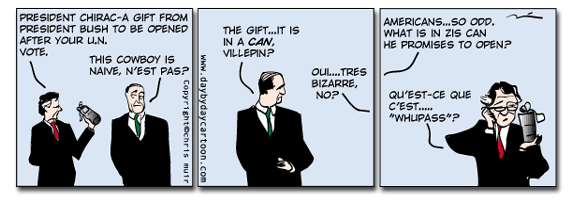
On the appeaser front, German Chancellor Schroeder is being realistic and stated that the chances of reaching a peaceful resolution to the Iraqi crisis were slimmer than ever. He has even closed the Geman embassy in Baghdad. Chirac continues to play politics. Ever since agreeing to resolution 1441, which gave Iraq 60 days to comply with UN demands or face "serious consequences", Chirac has since refused to consider realistic deadline. Fearing he had overplayed his hand by unilaterally stating he would veto any future UN resolution, Chirac said he would consider a 30-day deadline for the inspectors to finish their work. This is too little, too late. It looks like the French realize they are going to be blamed by most Europeans when the UN is ignored. One of their ministers is now urging the Pope to become a human shield for Iraq.
The international reaction to the UN deadline was mixed throughout the world is mixed, as one would expect. Japan and Australia strongly support the Liberate Iraq position, India is playing a neutral role, and China and Indonesia continue to oppose military intervention. When all is said and done, the announcement probably didn't change the minds of anyone. Nor was it expected to do so in my opinion. Bush, Blair, and Aznar - representing the Coalition of the Willing - are giving the UN one last chance to live up to Resolution 1441. If it does not, and given Chirac's promised veto it probably will not - it will be ignored and the people of Iraq will be liberated despite the French, Geman, and Belgium governments.

After the war is over, Bush Has Audacious Plan to Rebuild Iraq Within Year. Washington is under international pressure to broaden a postwar rebuilding effort, even as it continues to do battle with traditional allies over the merits of launching a war on Iraq. The article doesn't mention from where this "international pressure" is coming, but it is most likely coming from the same people who want to continue to appease Saddam. If so, the hypocrisy of leaders who say "Don't liberate Iraq, but if you do use your military at your expense, make sure your hire some of our firms to rebuild Iraq" is striking.
If any of the oppressed people in Iraq are reading this, your liberation should soon be at hand. I recommend that my American readers fill up their gas tanks today as prices will probably spike as soon as the war is announced or starts.
Do What I Say, Not What I Do
This German educator could be the poster boy for the French, Hollywood, and other hypocrits. Assuming he actually goes to jail (a big assumption), perhaps he could go into politics when released. He should fit right in.
Another Hope for the Iraqis
After all the diplomatic dancing is finally finished, and after the US and its allies depose Saddam, what will become of the Iraqi people? Many people on the Left seem to have the "soft bigotry of low expectations" because they do not believe an Arabian democracy is possible. Not only is this racist argument, it is a familiar one. After WWII, our grandparents were partaking in similar discussions. It is impossible for the Japanase people to form a democracy, after all they worship an emperor. And don't even think about giving democracy another chance in Germany - they elected Hitler. Obviously these arguments were wrong. Likewise the arguments against a democratic Iraq are also flawed.
Some of my friends on the Right frequently challenge me to come up with just one thing Clinton did right as president. Actually, I think Clinton accomplished several good things including saving the Muslims in Kosovo. It should be noted that the UN and Europe dithered around on this while Muslims were being slaughtered just as the UN and parts of Europe (France, Germany, and Belgium) do everything they can to keep Saddam in power despite his brutal oppression of the Iraqi people. Fortunately, President Clinton ignored the UN and intervened. The freed Kosovars are now undergoing the difficult process of creating a nation with the help of the UN (one of the places where the UN can actually be helpful). It is wonderful to see that these people have the character to refuse unwanted help, the desire to build a civilized nation, and are thankful to the US for their liberation.
Unlike Bosnia, another Muslim and former Yugoslav republic, Kosovars have refused offers from Saudis to build mosques and madrassas -- Islamic Koranic schools, demanding instead that the money be allocated toward building hospitals, secular education facilities and "more useful institutions." Kosovars have also strongly resisted offers from Islamic groups to "behave in more Islamic ways," such as the demand that women adopt the traditional Islamic veil, or that men grow beards, as some Wahhabi groups have tried to impose on Kosovars, according to OSCE officials.Why would the people of Iraq be any different? Indeed, their complaints will probably be on the lines of "What took you so long? Why didn't you do this 12 years ago?" But future Iraqi-American relations should be very positive. I wonder what the Iraqis will tell those who tried to stop their liberation?For that matter, nowhere is the United States more popular than in Kosovo, where Americans are seen as heroes, having saved them from the grips of Milosevic's repressive policies. A huge painting depicting Kosovo's newest hero -- former U.S. President Bill Clinton -- covers the entire facade of a tall apartment building in the center of town. The building is situated on the boulevard bearing the name of the former American president, a testimony to the support, gratitude and admiration Kosovars have for the United States. "When the World Trade Center towers collapsed, we felt that we were being attacked," said a Kosovar journalist. "We lit candles and we cried with America."
Marx and Current Anti-Americanism (Hat tip Paul)
If you enjoy economic or socialist philosophy, you may be interested in this article by Lee Harris. It is a thoughtful look at another perspective.
Eat an Animal for PETA Day (hat tip Instapundit)
In response to PETA's tasteless comparison of the eating of animals to the Holocaust, tomorrow is International Eat an Animal for PETA Day.
I've already received a letter from a child of Holocaust survivors who is, of course, extraordinarily offended. But here's the thing: PETA is known for this kind of outrageous publicity stunt--and that's what it is, an outrageous publicity stunt--and while I am also offended and outraged, there is absolutely nothing we can do that will make PETA change their ad campaign. I'm sure they knew exactly what they were doing, have a plan in mind, and, if they withdraw the campaign, will do it according to their deadlines and their decisions.So let's make up our own outrageous publicity stunt. Let's designate Saturday, March 15th, as International Eat an Animal for PETA Day. Everybody set the date on your calendar, and either go out and enjoy a great steak, or cook one at home. Or cook up some chicken or fish or anything else that PETA wouldn't want you to eat. And let's let PETA know how their ad campaign has affected us.
Meryl suggested emailing PETA letting them that you are deliberately eating more animals because of their campaign. That's a good idea, but doesn't go far enough. When organizations cross the line, as PETA has, I recommend hitting them where they hurt – in their pocketbook. Go to this PETA site and ask for a free vegetarian starter kit. It cost PETA money to produce, store, and ship these kits. Sign up your friends. After you get your free kits, then email PETA and tell them you ordered your kit to protest their campaign. If possible, use an email address that does not give away your name or shipping address. Let PETA try to figure out what names on their list are potential donors and what names are protestors...
A Drugged Society
It has been clear for some time that too many people believe drugs are the solution to any undesired behavior, no matter how natural the behavior. Six percent of American kids are now on prescription drugs to control their behavior! Six percent! And now a flight attendant has been accused of giving a 19-month-old passenger Xanax, an anti-anxiety drug, because the girl was squirming and restless. The attendant did this without the knowledge or permission of the girl's mother by simply spiking some apple juice. Fortunately the mother became suspicious after seeing the juice had blue and white specks in it and had the juice analyzed.
What a world.
The Accordions of War, Part VI
Many people have questioned Chirac's motivation for vehemently supporting Saddam Hussein. Italian writer Oriana Fallaci believes Chirac does not care about the Iraqis, but for oil.
...the mellifluous Jacques Chirac does not give a damn for peace but plans to satisfy his vanity with the Nobel Peace Prize. Where there is no wish to remove Saddam Hussein because Saddam Hussein means the oil that the French companies pump from Iraqi wells. And where (forgetting a little flaw named Petain) France chases its Napoleonic desire to dominate the European Union, to establish its hegemony over it.
Likewise, the analysts at Jane's believe Chirac understands what he is risking, but considers playing for European influence is worth the risk.
France used to have large oil interests in Iraq, and a reasonable expectation of retaining some influence in the region. Chirac's current policy has put all this at risk. The French attitude has also split Europe, with Britain, Spain, Italy and the former communist countries in eastern Europe now deeply suspicious of Paris. The French leader always knew that, ultimately, he could not stop the USA from resorting to war. So why is he persisting?Mainly because he believes that all the disadvantages pale into insignificance in comparison with the ultimate prize: a France that leads all those willing to stand up to US 'arrogance' around the world, a France that articulates Europe's distinct opinion and enjoys a good reputation in the Arab world as well.
It is clear that Chirac’s position is simply driven by politics, not principles (unless you count the desire to reduce American influence as a principle). From a political perspective, the question then becomes "Is Chirac's gamble a wise move?" I believe the answer is no. The Economist shares my perspective:
Mr Chirac has won glowing reviews as the man who is doing a fair job of taking the superpower down a peg or two. France would not be France if its president did not occasionally try to puncture the grandiosity of an America accused as ever of taking the acquiescence of smaller nations for granted. But what if, now that he has picked this particular fight, Mr Chirac proceeds to lose it?This could now happen in very short order. America and Britain have given themselves only a couple of weeks to pass their new resolution. Should they fail--either because they cannot muster a majority or because another of the permanent five casts a veto--Mr Bush will almost certainly feel compelled to fulfil his promise to go to war anyway. If the war goes badly, bringing disaster all round, Mr Chirac will be able to claim a barren sort of vindication. But if it goes even half-way towards achieving Mr Bush's vision of a democratic future for the Middle East, France will have absented itself from a history-changing intervention in a part of the world where it has long claimed a special influence. It will also have demonstrated the impotence of the Security Council, the very institution from which the French (and British) derive so much standing by virtue of being veto-wielding members.
I wonder what French historians will think of Chirac if his actions result in a further reduction of international French influence and the loss of sizeable revenue contracts to French firms? It will probably part of the concluding paragraph on his rule, next to mentioning his telling the Eastern European nations to shut up. I am glad I am not in his shoes - that is a legacy to avoid.
Small Steps for Children
It is good to be reminded that the world goes on while the UN dithers. The Smart child was reunited with her family months after the police wrote her off for dead. And the Senate passed a bill making partial birth abortions illegal. It will doubtless pass the House and be signed by President Bush. The only question is whether or not it will survive the Federal Courts. No wonder the Democrats are trying to defeat Bush's judicial nominees, they do not have the votes to implement their desires and need the courts to do it for them. Banning the barbaric practice of partial birth abortions is a small step toward banning abortions, but at least it is in the right direction.
Day by Day
Dean Esmay has been listed under my communication links almost as long as I have been blogging. Today he showed yet again why he remains there. He interviewed a brilliant cartoonist, Chris Muir, who seems to be an independent after my own heart.

Media and the War: A Change in Perspective
For many decades, the US military and the US press have not had a close relationship. There are many reasons for this, not least that those in the military tend to be very conservative and the media mostly attracts liberal types. However, the US military has decided to allow and invite the media to cover the war as closely as they dare. While the owners of major media companies are thrilled with this decision, some of the reporters are wondering if this is actually a good idea from a personal perspective. They are now being asked for their blood type in case they are shot or step on a landmine. They are undergoing training on how to put on protective gear in case of a chemical or biological attack. The Salt Lake Tribune wonders whether today's breed of foreign correspondent -- out of shape and more at home in a five-star hotel than an open night on the battlefield -- can hack it on the front lines.
It looks like the military has given this a lot of thought. The Pentagon promises unit commanders will not censor reporting. But because modern technology allows near instantaneous coverage, journalists are required to adhere to basic rules of operational security. In other words, do not publicize pending operations. When operations begin, the news media will be under a blackout for an unspecified period of time. Thus, having the media along should not pose a grave risk to our military. Assuming this assumption is correct, this approach could have benefits. It may give those in the media some respect for the competence and bravery of our soldiers.
With some reservations, I think this could be a good thing. However, I hope the networks carefully consider what they broadcast. I worry that in a race for ratings they could use live war footage as a modern version of gladiator games. It would be criminal for them to use American soldiers in this manner. Imagine if a child at home saw his father killed on live TV? If any of my readers work for a network, or know someone who works for a network, please ask them to carefully consider how they will handle such events before they occur.
It appears that the military's new openness to the media also applies to the foreign press. According to Oliver North, some hostile reporters are already trying to annoy our troops. Never fear, our soldiers can handle it.
...the Pentagon has provided press credentials to a significant number of foreign journalists. Unfortunately, many of the international media appear to have an overt hostility to the subjects they are covering.And that says it all.One female correspondent from a European news service was overheard asking -- or was it telling -- one of the Marines that she had "never seen so much bravado, machismo or arrogance" in her life. The young NCO listened and appeared to mull over her grievance before replying, "Yes, ma'am, that's why they call themselves U.S. Marines."
Mother of All Bombs
Before the first Gulf War, Saddam Hussein promised the Mother of All Battles if the US interfered with his conquest of Kuwait. Since he had more firepower under his control than Germany did in WWII, he felt confident in this claim. However, he did not realize how advanced the US military had become and Saddam's vaunted military might was quickly demolished by the US and its allies.
The US military has continued to improve its technology and yesterday it tested a 21,000 pound bomb, a larger version of the daisy-cutter used in Vietnam and Afghanistan. It is the largest conventional (non-nuclear) weapon in the world. It belongs to the MOAB class of bombs. Officially, the acronym stands for Massive Ordnance Air Burst. In a not-so-subtle reference to Saddam's vain boast, our soldiers are unofficially calling it the mother of all bombs. One of the many uses for this type of bomb is to destroy secured bunkers - and it can be dropped by bombers flying well above the range of any anti-aircraft weapons Saddam may posses.
The Miami Herald has a video of the bomb's test available. If you watch it, keep in mind that the explosion is filmed from about 12 miles away.
Out of the Mouths of Children (Hat Tip to Sir Dave)
Jesse Jackson is visiting a primary school and he visits one of the classes. They are in the middle of a discussion related to words and their meanings. The teacher asks the Rev. Jackson if he would like to lead the discussion of the word "tragedy." So the illustrious leader asks the class for an example of a "tragedy."
One little boy stands up and offers: "If my best friend, who lives on a farm, is playing in the field and a runaway tractor comes along and knocks him dead, that would be a tragedy."
"No," says the Great Jesse Jackson, "that would be an accident."
A little girl raises her hand: "If a school bus carrying 50 children drove over a cliff, killing everyone inside, that would be a tragedy."
"I'm afraid not," explains the exalted spiritual leader. "That's what we would call a great loss."
The room goes silent. No other children volunteered. Rev. Jackson searches the room. "Isn't there someone here who can give me an example of a tragedy?"
Finally at the back of the room a small boy raises his hand. In a quiet voice he says: "If a jet carrying the Rev. & Mrs. Jackson were struck by a missile and blown to smithereens, that would be a tragedy."
"Fantastic!" exclaims Jackson, "That's right. And can you tell me why that would be tragedy?"
Well," says the boy, "because it certainly wouldn't be a great loss and it probably wouldn't be an accident either."
New Logo for the UN
Rip Rowan has designed a new logo for the UN. It certainly seems more appropriate than the UN's official logo, Never Again. I think many within the UN have forgotten what happened the last time the French tried to appease a dictator. At least the English Prime Minister has learned from history.
The new logo is posted with the author's permission.

I suggest you visit Rip's site - usually concise and witty; a nice combination. And even if the UN doesn't officially adopt Rip's suggestion, it would make a fitting epitaph should the UN join the League of Nations.
Another Reason I am an Independent
I am an independent and not beholden to either the Democratic or Republican parties. Along with my Democratic friends I share their distaste for the Patriot (Big Brother) Act. That Patriot Act was in my mind when I completed a survey for the Democratic party today. It left a bitter taste in my mouth.
During part of the survey, I was asked What kinds of actions would you take to support the Democratic Party? (check all that apply). So far, so good - I had volunteered to complete the survey and I am willing to spend time being an activist on issues of importance to me. So I expressed my willingness to discuss issues in online discussion groups and had completed most of the survey. Then I came to this:
* Protest a local Republican Party event
One of my criticisms of the current Democratic party is that they no longer stand for much. They are neglecting their tradition role as defenders of civil liberties and seem to be simply against anything the Republicans promote. Democrats need to stand for something other than abortion on demand. They need to be proactive, not just react to Republicans. So the protest option just made me sigh briefly and I went on with the survey. At least until I hit the next option:
* Join a "neighborhood watch" and report on local GOP events and mailings in your town
This really irritated me and made me wonder if the Democrats no longer have any ethics. They let the Patriot Act pass last year without debate when they controlled the Senate, clearly ignoring their responsibilities as both the majority party and as defenders of civil liberties. After it passed, they now complain about the infringement of our civil liberties (and I mostly agree with their protests, but they are the ones that passed it). And now, they ask volunteers to spy on their Republican neighbors? I'm disgusted.
When I left their site, I got a message asking me to donate. It said Democrats can't win without you. I hope so.
UN Update
It looks like President Bush does not (yet?) have the nine votes he wanted at the UN Security Council and has delayed the vote for at least another day. Chirac has promised to veto the resolution if it does pass, making one wonder how much longer President Bush will continue to waste time with the UN. Voice of America quotes President Bush if the United Nations does not follow up on its commitment to disarm Iraq, even if that means war, the international body will become irrelevant.
Portugal has come out in support of the US because they appreciate the US's role in keeping the peace. Foreign Minister Antonio Martins da Cruz has a realistic grasp of foreign policy. I say this not just because he agrees with me, but because he understands the problem of the EU spending so little on defense.
...if Portugal were attacked, "it would be unlikely France and Germany would come to our rescue."He said: "Let us suppose Portugal, proper or its archipelagos, faced a threat, who would come to our rescue? The European Commission, France, Germany?
"I think it would be NATO who would come to our rescue, in other words, it would be the U.S., no one else would defend us. For instance, during the 1996 mission in Bosnia, operations took place with the support of 20 satellites, of which only one was European," and the remainder belonged to the U.S.
"If we were attacked, is that what they would offer to defend us? How curious is this: in Bosnia, when we were called to send soldiers urgently to that region, the U.S. had C-17 and C-130 planes, and France leased ferry boats, which during the summer are employed in tourist services to Corsica.
"Is this how we are supposed to project our forces in Europe? Are they planning to defend us with ferry boats? I cannot envisage the European Commission protecting us from an attack in which highly developed weapons were employed," the foreign minister said.
Spanish Prime Minister Jose Maria Aznar strongly questioned the rationale for those supporting the continued reign of Saddam Hussein.
"We don't have any material interests in Iraq...France has material interests in Iraq. Russia has material interests in Iraq. China has material interests in Iraq. We don't have any," Aznar told Telecinco television in drawing a distinction between governments on opposing sides within the U.N. Security Council.Asked by the interviewer if those interests explained the French, Russian and Chinese positions on Iraq, Aznar said, "That's a question only they can answer."
Aznar said Iraq was a threat to Spain. "If in the end military intervention is unavoidable, I will not shed a tear for that regime because it is a threat to everyone, Spain included," he said.
I believe Aznar's sentient is shared by most citizens and governments outside of France, Belgium, and Germany. We live in a time of change and change is frightening to those in power. However, I believe those fighting to keep Saddam in power are doing more harm than they realize. Only George Bush knows when the war will officially start, but I don't think it will be much longer.
Blix's Integrity Under Challenge
Until recently, I have found myself becoming a fan of Hans Blix, the chief UN weapons inspector. He obviously opposes a war with Iraq, but has been honest in his reports to the UN. He has a thankless job and is under intense pressure. From all accounts he has been performing it well and with integrity. For that, he has earned my admiration and hopefully that of many others.
However, I fear the pressure has overwhelmed him. He now stands accused of hiding evidence of another Iraqi weapon - an unmanned drone. This weapon was not mentioned in his last report to the UN council and was found buried in a 173 page UN report by US and UK diplomats.
According to the Sydney Morning Herald:
London and Washington were planning to demand that Blix reveal more details about the aircraft, which has a wingspan of 7.45 metres and would possibly be capable of delivering weapons of mass destruction.
According to the London Times, this is having a major impact on the remaining six undecided votes on the UN Security Council.
"It's incredible," a senior diplomat from a swing voter on the council said. "This report is going to have a clearly defined impact on the people who are wavering. It's a biggie." An explicit report by Dr Blix of the discovery of an Iraqi violation would help the six swing voters -- Angola, Cameroon, Chile, Guinea, Mexico and Pakistan -- to explain a change of position to their publics.Unlike the outlawed Al-Samoud 2 missile, which was declared as a purportedly legal weapon, the drone was not declared. It would be the first undeclared weapons programme found by the UN and is considered by British and US officials to be a "smoking gun".
Others mostly quote the London Times or New York Times. I haven't read the NYT's article (subscription), but it apparently had some details about some newly discovered Iraqi rockets that could deliver weapons of mass destruction.
U.N. inspectors have uncovered a new variety of Iraqi rocket that was apparently configured to strew bomblets filled with chemical and biological agents, The New York Times reported Monday, citing U.S. officials.
It will be interesting to see how the UN vote actually turns out. If the swing voters needed it, this could easily provide them with political cover for supporting the Liberate Iraq position. No matter how the vote turns out, I fear the war to Liberate Iraq has resulted in yet another casualty - the integrity of Hans Blix.
Iraqis Surrender (Hat Tip: Dean)
TERRIFIED Iraqi soldiers have crossed the Kuwait border and tried to surrender to British forces - because they thought the war had already started. The motley band of a dozen troops waved the white flag as British paratroopers tested their weapons during a routine exercise."The Paras are a tough, battle-hardened lot but were moved by the plight of the Iraqis. There was nothing they could do other than send them back. "They were a motley bunch and you could barely describe them as soldiers - they were poorly equipped and didn't even have proper boots. Their physical condition was dreadful and they had obviously not had a square meal for ages. No one has ever known a group of so-called soldiers surrender before a shot has been fired in anger."
While funny in a dark sense, I find this sad. Surely the British could have let them stay - I suspect these soldiers are now in an Iraqi prison at best. If the British had been prepared for this, the headline could have said "Iraqis Defect." The Iraqi soldiers could have been fed, debriefed, and already be in training as the police for the new Iraqi regime. Hopefully the coalition of the willing will learn from this and plan for additional "early" surrenders.
Response to Susanna et al & Religious Tolerance
This started out as a short comment to a post of Susanna about religion and to some of the comments that followed. However, it grew large enough that I decided to also post it at Solport. I usually focus on current events, politics, economics, and science; but I also found this interesting.
I agree with Susanna's main point that the Jewish leaders of the time plotted to obtain the death of Jesus. I disagree on some minor points. For example, while the majority of Jewish leaders supported killing Jesus, I do not believe it was unanimous. Nicodemus was both a follower of Christ and an influential Pharisee (see John 7:50-52). I also strongly disagree with Susanna's statement that Christianity "directly contradicts Judaism." Rather, if you accept the New Testament, Jesus is the fulfillment of Judaism. Keep in mind that the first Christians were all Jews, including the original twelve disciples and Paul (Saul), a zealous Pharisee leader who even held the coats of those who stoned Stephen, later converted and wrote 25% of the New Testament. Jesus first approached the Jews, then the Gentiles. However, I believe Susanna meant that Christianity contradicts modern Judaism and I would agree with that.
Some comments in response to Susanna discussed the historical accuracy of Jesus and denied that Jewish leaders had anything to do with the death of Jesus. While the musings of modern day academics are interesting, most historians will be the first to tell you how much subjectivity goes into their analysis of ancient events. I'm working on my PhD myself, trust me I know of what I speak... Thus, I prefer to go to the original sources. Christians take comfort in that there is more written support for the books of the New Testament than any other body of ancient literature. Over eight thousand Latin, five thousand Greek, and many additional texts in varied languages support the books of the New Testament.
However, many non-Christians refuse to consider the New Testament because it was written by followers of Jesus. Consider the words of Josephus, a Jewish historian who was born in AD 37 (a few years after the crucifixion of Jesus). His comments are well regarded by most secular, Jewish, and Christian historians. I remembered he wrote a little bit about Jesus and I looked up Josephus' comments on Jesus (Book XVIII, part of the story of Herod the Great).
On the accusation of the leading men of our people, Pilate condemned Jesus to death upon the cross; nevertheless those who had previously loved Jesus still remained faithful to him.
So even if one ignores the evidence of the New Testament, the evidence of a Jewish historian clearly shows that Jewish leaders plotted the death of Jesus. This is so clear I find any debate about this fact surprising. I agree with Susanna's analogy - it is like people debating the historical accuracy of the Holocaust. Any reasonable person would agree it occurred.
Mike van Winkle wrote that "The beliefs of the founding fathers were far from monolithic. In fact many were deists who were christians by birth and culture." This is an exaggeration. It has been a while since I have reviewed my American History, but only two or three of those who signed the US Constitution were Deists. The rest were strong Christians - various Protestant denominations, true enough - but I'd hardly say many were Deists. Rather, the Christian majority practiced the religious tolerance of which they preached.
I don't expect my words will cause anyone to change their minds in their beliefs; although I remain optimistic that the intellectually honest ones will consider the words of Josephus regarding their discussion with Susanna. However, this exercise has made me thankful anew I live in a country that was founded on Christian ethics and practices religious tolerance. The alternatives are horrible to contemplate. Consider the historical impact of religious intolerance in Ireland between Protestants and Catholics or in India between Hindus and Muslims. Consider the historical value of life in officially atheistic nations such as the former U.S.S.R.. God bless the USA so long as it remains true to its core values.
Welcome Charlie
Charlie Daniels wrote an open letter to Hollywood that has been making the rounds through the internet. After a brief search I discovered Charlie had his own soapbox which had the original letter. I've added Charlie's Soapbox to Solport's weekly reads.
United We Stand
My European readers frequently ask how many Americans support the war. This question is very pertinent to them as some European politicians are taking stands with which many of their constituents may disagree. I typically reply that no one wants a war just for the sake of war, but most Americans strongly believe a war is a lesser evil than leaving Saddam in power. Less people will probably die in a war with Iraq than Saddam has killed in a year. But to fairly answer the question, I usually point out there is a sizeable minority on the American Left that supported the French position. However, this is starting to change.
When liberal columnists from Slate start agreeing with conservative columnists from the Wall Street Journal, one knows that America is uniting on an issue. Slate is critical of the thinking of German and French leaders - calling their schemes to keep Saddam in power part of a con game. Admittedly William Saletan isn't the clearest writer in the world, but my point is that many voices of the American Left are now joining their counterparts on the Right in a chorus to liberate Iraq. While Americans are aware of the protests in parts of Europe, they don't really care. Daniel Henniger (WSJ) points out:
The last time I recall the streets of Europe teeming with anti-American sentiment was 20 years ago, over the successful installation in Germany of the Pershing missiles, which began the final chapter in the Cold War. That famous spasm of anti-Americanism was not shared in 1983 by the citizens of Estonia, Latvia, Lithuania, Bulgaria, Slovakia, Slovenia, Romania, Albania, Macedonia and Croatia--the formerly unfree nations that today call themselves the Vilnius Group and whose leaders last month signed a statement in support of the American position on the Hussein government.
In fact, I believe the European protests are aiding in the converging of the American Left and Right to strongly support a Liberate Iraq policy. This may also be another sign that the war has already started. In America, the loyal opposition is free to argue the opposite side of an issue to ensure that decision makers consider the consequences of their decisions. Not only are the loyal opposition free to disagree, they are expected to do so - this is one of the strengths of a two-party system. However, once a decision has been made, most Americans then close ranks and support the decision. I believe we are seeing that occur now.
By the time the war enters the next stage, only the most radical politicians and protestors will continue to support Saddam in America. The overwhelming majority of Americans will be supporting the liberation of Iraq and watching the rest of the world with unusually interest. We will want to see who else cares about the Iraqi people and who continues to argue that Saddam should remain in power.
Russian Diplomacy
Den Beste pointed me to an article by Anatole Kaletsky of the Times. It was an interesting article, but Den Beste didn't reference the part that I found most interesting.
But probably the biggest loser from the new global disorder after a veto at the UN by France or Russia would be Europe itself -- and especially the "old Europe" dominated by Germany and France.Not only will the Franco-German betrayal of its erstwhile US ally lead to the demise of NATO (a goal which the Russians may well be trying to promote by apparently supporting France).
Ignoring the fact that Kaletsky didn't complete his sentence, I find this thought intriguing. Russia's military is not happy with the prospect of their former soviet pawns joining NATO for the same reasons that countries like Poland are joyfully applying to join. However, Russia knows they cannot stop these countries from joining NATO and even attempting to do so would be a poor move on their part. But what if there were no NATO?
The Russians are sophisticated politicians and very much served by self-interest. As they should be - so long as their politicians keep the self-interest of their country in mind vs. their personal interests. Russian politicians have been very careful not to fully commit to either side. On one hand, Russia is owed billions by the Iraqi government and Russian firms have rich contracts they would like to see honored. France and Germany are also opening up their markets to some Russian goods, and the Russians want to encourage this. On the other hand, Russia wants to strengthen their relationship with the US for many reasons, including both military and economic issues. However, Russian resistance to the liberate Iraq plan has grown stronger ever since the French, Germans, and Belgiums showed that NATO was subject to the same internal politics as the rest of Europe. Russia may have decided that the chance to eliminate NATO is too great an opportunity to miss. If they believe that their support of France and Germany has a chance of eliminating NATO, then this is going to be a major factor in their decision-making.
The War Has (Unofficially) Started
While people continue to debate what the UN votes will or will not achieve, I believe the war has already started. As the following headlines clearly show, the first stage of the war has begun.
Iraqi jets repeatedly penetrated no-fly zone, U.S. military says - March 1, San Diego Union Tribune
No-fly zone raids 'opening new war' - March 4, The Guardian
No-fly zone attacks escalate - March 4, CanWest News Service
Downing Street defends attacks in no-fly zone - March 5, Financial Times (subscription)
U.S., allied jets double flights over 'no-fly' zone - March 6, Oakland Tribune
Britain and US triple patrols in no-fly zone - March 7, Independent
U.S., British aircraft attack Iraqi mobile radar - March 7, Reuters
U.S. air patrols over Iraq fired upon - March 7, Salon
Marines cut through border fence - March 7, The Guardian
The US and UK militaries have been clearing a path for a large-scale assault. Their fighters have destroyed Iraqi radar installations that would let them see the allies coming. Tank-sized holes have been cut in the fence at the Kuwait-Iraq border.
I suspect that shortly after the UN votes on yet another Iraqi resolution, the next stage of the war will start. As discussed earlier, the UN vote is mostly to see if they have the courage to stand by their earlier 18 resolutions. However, my point in this post is that the initial stages of the war have already started. I expect to see the next stage, cruise missiles and a massive bombing attack, shortly after the UN vote unless Saddam disarms immediately.
Bush's Speech
I had to work late last night and missed Bush's speech. However, Lady Quixote watched it and filled me in. I also read the transcript. My wife said Bush looked tired (as one might expect), but clearly made his points. From her comments and reading the transcript, I believe that this conference was mostly aimed overseas. Here is a sample of the speech.
QUESTION: Thank you, Mr. President. As you said, the Security Council faces a vote next week on a resolution implicitly authorizing an attack on Iraq. Will you call for a vote on that resolution, even if you aren't sure you have the votes?BUSH: Well, first, I don't think -- it basically says that he is in defiance of 1441. That's what the resolution says. And it's hard to believe anybody saying he isn't in defiance of 1441 because 1441 said he must disarm. And yes, we'll call for a vote.
QUESTION: No matter what?
BUSH: No matter what the whip count is, we're calling for the vote. We want to see people stand up and say what their opinion is about Saddam Hussein and the utility of the United Nations Security Council. And so, you bet. It's time for people to show their cards, let the world know where they stand when it comes to Saddam.
QUESTION: Mr. President, are you worried that the United States might be viewed as defiant of the United Nations if you went ahead with military action without specific and explicit authorization from the U.N.?
BUSH: No, I'm not worried about that. As a matter of fact, it's hard to say the United States is defiant about the United Nations when I was the person who took the issue to the United Nations September the 12th, 2002. We've been working with the United Nations. We've been working through the United Nations.
Secondly, I'm confident the American people understand that when it comes to our security, if we need to act, we will act. And we really don't need United Nations approval to do so. I want to work -- I want the United Nations to be effective. It's important for it to be a robust, capable body. It's important for its words to mean what they say. And as we head into the 21st century, Mark, when it comes to our security, we really don't need anybody's permission.
President Bush was being very clear that he supports the international community, but he expects people to do what they said they would do. When Resolution 1441 passed, every member of the security council voted for it and paid lip service to 60 days to disarm or severe consequences. 60 days passed and everyone agrees that Saddam has not disarmed. Yet some people want to give Saddam even more time to disarm despite his ignoring UN resolutions for over 12 years now. Many people are treating this as a game where the US and the UK are on trial at the UN. This is no game and Saddam will be disarmed by many nations including the US if he doesn't disarm very quickly now.
It is clear that President Bush is going to force a vote at the UN. From an American perspective, the UN is on trial. Will they live up to Resolution 1441? Or will the security council remain a divided paper tiger? If the latter, I wonder how long it will be before the UN joins the League of Nations?
The Accordions of War, Part V (Hat Tip Merde in France)
The Washington Post claims that the French have been helping the Iraqi military prepare for war.
French company has been selling spare parts to Iraq for its fighter jets and military helicopters during the past several months, according to U.S. intelligence officials.The spare parts included goods for Iraq's French-made Mirage F-1 jets and Gazelle attack helicopters.
I hope this is not true. If it is, this is despicable, even for the French. So far, only the Washington Post has filed this story - all the others I have seen quote them. I will be watching this closely to see if this is confirmed.
Employment Problems
I've updated Solport's charts on U.S. employment. By my index methods, the employment picture is starting to look bleaker. If you ask three economists for the reason why, you'll get five answers... My estimate is simply that the uncertainties of war are causing many employers to hold back until they see the impact of the war. To paraphrase Shakespeare, since war is coming, let's do it quickly.
Busy Week
Light posting this week. In addition to my normal work routine, I also had to clear my driveway of nine inches of snow yesterday. Ah well, variety is the spice of life.
Terrorists on the Run
Apparently a captured low-level terrorist was responsible for the capture of al-Qaeda operations chief Khalid Sheikh Mohammed in Pakistan. The informant will receive a multi-million dollar payoff and a new identity. Mohammed is believed to be a treasure-trove of knowledge about al-Qaeda since he was one of their strategic planners. Al-Qaeda knows this and has taken steps.
Bin Laden had offered a similar reward [500,000 pounds or about $750,000] to the family of a suicide bomber who kills Mohammed, according to the paper. An unnamed source told the Sun that Mohammed "knows too much and they want him silenced - fast".Mohammed is considered the number three in the al-Qaeda network after bin Laden and his Egyptian deputy Ayman al-Zawahiri. Mohammed is believed to have been the architect of the September 11 attacks.
This capture was a great victory in the war on terrorism. I feel all Westerners should be thrilled with this, but ScrappleFace disagrees.
The Patriot Act
Axel (Germany) asks:
I just read in a German magazine about the 'USA Patriotic Act', which was issued about six weeks after 9/11 with close to no discussion in congress. It allows FBI agents (among other things) to investigate the reading habits of US citizens by checking library accounts and data collected by book dealers. Before this law, a judge had to issue a search warrant to legalize these actions. Now the police do not need to prove a connection to a crime any more.First statistics indicate that these powers are indeed widely used.
Is this information correct? What do you think of this practice?
The information is somewhat correct. The Patriot Act was signed by President Bush on October 26, 2001. Congress rushed this legislation through so they could say they were doing something in response to September 11 before the November elections (first Tuesday in November). In my opinion, Congress neglected their responsibilities and did not act in a mature manner. Both parties are responsible for this, but I was shocked by the actions of the Democrats at the time. They traditionally prefer to err on the side of civil liberties vs. national security while Republicans tend to err on the side of nationality security over civil liberties. The Democrats controlled the agenda of the Senate at that time since they had the majority. However, they decided to spend their time arguing with President Bush and the Republicans about union rights in the new Homeland Security reorganization and rushed the Patriot Act through the Senate. Voters didn't appreciate their stance on homeland security and that is one of the reasons the Republicans now control the Senate. So not only did the Democrats get defeated on their Homeland Security stance, they ignored their traditional role as defenders of civil liberties.
However, the Patriot Act did pass. I'm not thrilled with it, but it is not too bad. Many of the provisions in the bill will expire on December 31, 2005 unless renewed by Congress. The other provisions may be revoked by future legislation after the war on terrorism is won. The US has a fairly good track record in this regard. In times of war, Congress usually reduces our civil liberties a bit to help our national security. When the war is won, Congress writes new legislation that restores civil liberties. There is always the chance that they will not, but my guess is that there will be a new Civil Liberties bill passed after the war on terrorism is over. That is the historical pattern of our government.
A Response to Friendly Spam (Hat Tip: Greg/New Jersey).
I have many friends who are not too technical. When they get an email saying "forward this to as many people as possible and we'll pay you for each one" they believe it. I no longer bother to tell them that there is no way for Microsoft to track their emails. However, a friend sent me the perfect response. Next time you get one of these pieces of friendly spam, send this URL to the culprit. It is a wonderful way to stop this practice while keeping your friends.
Vanilla Coke
I'm not a big consumer of soft drinks. If I want a sugary drink, I prefer fruit juice. However, I occasionally indulge, especially when I need a little caffeine. I've been putting in a lot of hours at work recently and had trouble getting up today. So I swung by the local 7-11 on the way to work. They had the new Vanilla Coke available at the fountain and I decided to try it. Before I give you my impression, I'll discuss Coca Cola's New Coke fiasco.
On April 23, 1985, the Coca Cola Company changed the formula for their flagship drink (Coca Cola or Coke). They were concerned that more and more people were drinking Pepsi. Coke has a more bitter, adult taste while Pepsi has a sweeter taste (almost carbonated Kool Aid, IMO). I've never cared for Pepsi myself, but it is very appealing to those who like sweet drinks. The New Coke was a very bad idea. It tasted like a second-rate Pepsi - it was very sweet. On July 11, 1985 - less than 3 months after the introduction, Coca Cola brought back the original formula.
I brought up this history because I think the Coca Cola Company learned from the experience. Vanilla Coke is not a replacement for Coca Cola, but an additional drink. Unlike the New Coke of 1985, Vanilla Coke is not a second-rate Pepsi. The vanilla makes the soda taste sweeter than regular Coke, but not too sweet. IMO, Vanilla Coke will appeal to those who like sweet drinks and is a better sweet drink than Pepsi. It'll be interesting to see how many Pepsi drinkers like Vanilla Coke.
Turkish Politics
The Turks surprised themselves and the world by refusing to allow US forces to launch a second front from Turkey. As an American, I was glad to see it. While it would be easier to attack from multiple fronts from a military perspective, I think the price was too high. Not only would it cost American taxpayers about $15 billion dollars for the "privilege" of attacking via Turkey, I am suspicious of Turkish intentions toward the Kurds and the northern Iraqi oilfields. The Turks are truly allies in the important matters and I am confident the US will defend them if they should be attacked. However, I agree with the wit who said the Coalition of the Willing was morphing into the Coalition of the Billing. I don't want my hard-earned tax dollars being given to others when there is so much that needs to be done at home.
If it comes down to money vs. the lives of American soldiers, then spend the money. However, I don't think the Turkish agreement boils down to that. It was a way to simplify the fighting at a high price. I am glad they said no and hope they do not reconsider.
The Accordions of War, Part IV
According to the Sun - a tabloid with less of a reputation than the National Enquirer - Chirac is facing scorn at home as well as abroad. Since it is the Sun, take this with a large dose of salt - it will be interesting to see if some of their points are confirmed by other papers or future events.
In a blistering phone call last week, President George Bush told the posturing Frenchman: "President Chirac, we will not forgive and we will not forget."A vote by Russia and China, along with Britain and America, in favour of a second UN resolution on military action would cut the ground from under Chirac. And it would sweep wobbly African states Guinea, Cameroon and Angola - along with Mexico, Chile and Pakistan - into the pro-war majority.
Chirac faces a humiliating climbdown in front of the world - or risks total isolation by using his veto at the UN. If he votes against action, America will sweep his protest aside and go to war immediately. A senior diplomat said: "More sophisticated French politicians are appalled with the way Chirac has gone out on a limb." They are desperate to avoid a vote of any sort in the UN.
I bet they are. Like most people, Chirac underestimated President Bush. Bush was patient and gave Chirac plenty of rope. I find it hard to sympathize with Chirac. I have some international friends who truly believe a war to liberate Iraq will do more harm than good. While I disagree, I can respect their opinion. However, Chirac has been enabling Saddam to rebuild for years. I will not have any sympathy for him when he goes down in history as the man who did more to reduce France's international influence than any other man in history. He earned that epigraph.
However, I'm not convinced that Russia and China will vote in favor of another resolution. I hope so. But I'm not as confident on this matter as the Sun.
The "Courage" of Their Convictions (Hat Tip: Michael of Canada)
Remember those protestors who were so against a war to liberate Iraq that they were willing to be living shields? Well, Saddam took them at their word.
Nine out of the original 11 activists decided to pull out after being given an ultimatum by Iraqi officials Friday to station themselves at targets likely to be bombed in a war or leave the country. Two left immediately by taxi and six others boarded the buses Saturday night, bound initially for Syria.
The eleven activists mentioned above were all British. Out of all the living shield activists from all countries "only about 65 of the volunteers had so far agreed to take up positions at the oil refineries, power plants and water-purification sites selected by their hosts."
It is difficult to advocate a ridiculous position when someone takes you at your word. I never thought I'd say thank you to Saddam, but I appreciate him introducing some of our more deluded Westerners to reality.
marines are the toughest men in the world the stupidest thing you could do in your life is to get on the bad side of a marine. semper fi!